
We asked our own supplier to prove the claim on the box. They couldn't.
Every plug-in fuel saver on the market advertises a number. Almost none of them can produce the test behind it. Here is what turned up when we went looking for one |
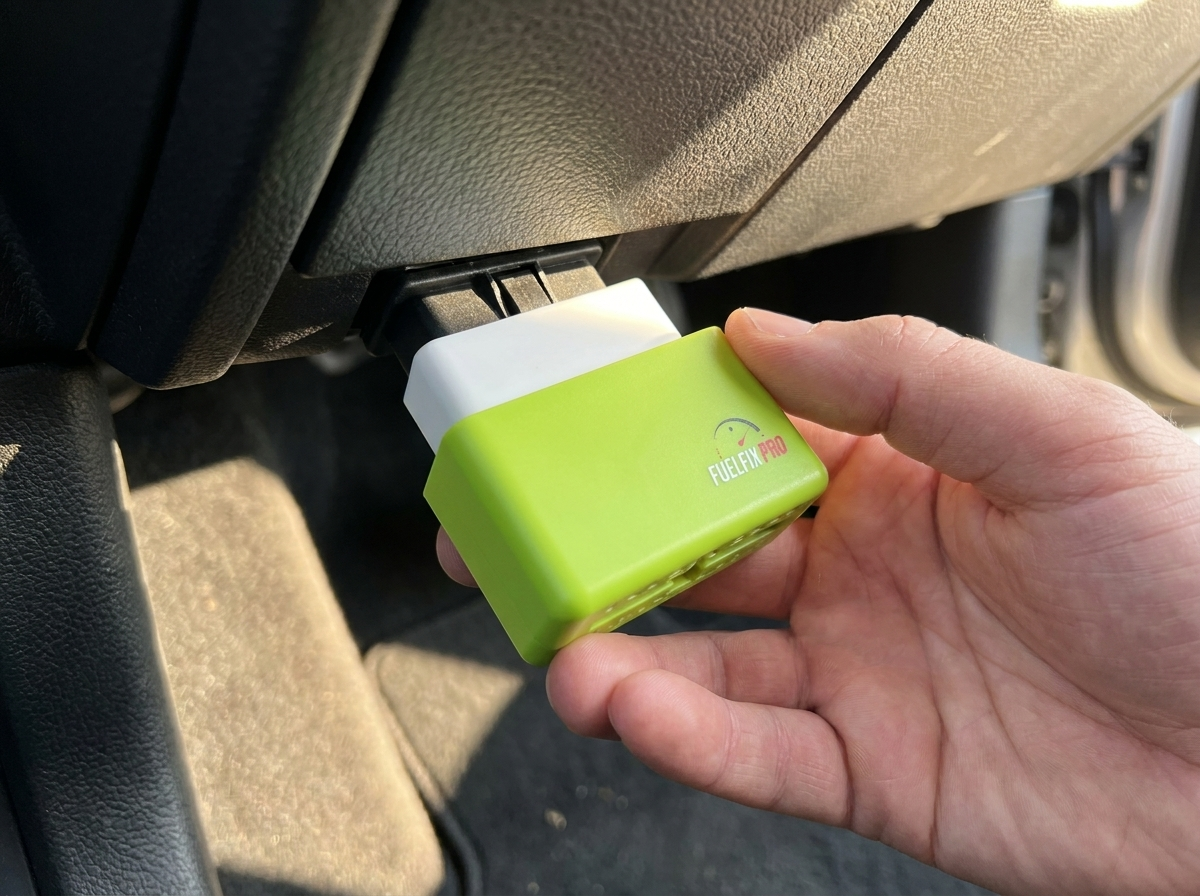
We asked our supplier a question that should have had a boring answer: can you show us the test?
The listing this device was sourced from advertised a double-digit improvement in fuel economy. That same figure appears on hundreds of listings, for hundreds of near-identical units, from dozens of factories. Before it went in front of a single customer, the study underneath it seemed worth reading.
What came back was a specification sheet, a wiring diagram, and the number again.
Not a lab. Not a protocol. Not a list of vehicles. Just the number, restated with more confidence than before — as though repetition were a form of evidence.
This page exists because of that exchange.
The number nobody actually owns
In this category the percentage doesn't originate anywhere. It gets copied. A factory puts it on a spec sheet, a trading company repeats it in a listing, a brand puts it in an ad, and by the fourth or fifth hop it has the texture of a fact. Ask any link in that chain for the source and you get pointed one link further back, until the trail simply stops.
Which would be a curiosity, except regulators have been documenting this exact pattern since the 1970s.
The Federal Trade Commission states that the EPA has evaluated more than 100 purported gas-saving devices and did not find any that significantly improve gas mileage.
The EPA's own position is that it does not approve, certify, endorse or register aftermarket fuel-saving products. Any advertisement implying otherwise is inventing an endorsement.
The FTC requires marketers to hold scientific substantiation before a claim runs, not after. Cases in this category have ended in lifetime industry bans and millions of dollars in consumer redress.
Forty years of that. And the ads still run, unchanged, today.
So why is it still on sale?
A reasonable question, and it deserves an answer rather than a slogan.
Because the hardware is real even where the marketing isn't. What's in the housing is a standard 16-pin OBD2 connector, a microcontroller that reads data off the vehicle bus while you drive, and an impact-resistant case. It's the same port a mechanic plugs a scan tool into. It doesn't remap the ECU, it isn't a tune, and there's no app or display — nothing to read, nothing to set up. It's also inexpensive to manufacture, which is why it sells for $38.99 rather than several hundred.
What nobody can honestly tell you is what it does to fuel consumption. The supplier asserts an effect. That assertion has never been verified. No published test on this specific device meets a standard worth citing.
That left two options. Repeat the number and hope nobody asks — the category's standard operating procedure, and judging by the FTC's case history a slow-motion legal problem. Or find out.
We're finding out. We're paying for the test the industry has spent four decades avoiding.
“We’d rather sell fewer units honestly and still be trading in two years.”
The results go on this page when they arrive, whatever they say. If the device turns out to do nothing measurable, we'll write that here in the same size type as everything else, and this stops being a launch and becomes a clearance.
Three things you won't find on this page
Deliberately absent, and worth naming so you notice they're missing:

Ninety days to change your mind, at our cost.
Questions people actually ask
This is paid advertising published by FuelFixPro about its own product. FuelFixPro is a plug-in vehicle accessory. We make no representation as to fuel economy or emissions performance pending completion of independent testing. Individual results vary with vehicle, condition, driving style and route. Not a substitute for scheduled maintenance and not a repair for an existing fault. The EPA does not approve, certify, endorse or register aftermarket fuel-saving products. Statements attributed to the FTC and EPA are drawn from their published materials and are not endorsements of this product.